
A good peer coaching session runs like a real client session: a clear agreement up front, focused exploration in the middle, a concrete next step at the end, and a few minutes of honest feedback after. The only difference is that next time, you switch chairs.
A peer coaching session is two trained coaches taking turns coaching each other. It is one of the best ways to build skill early on. You get practice with a real person working on a real topic, you get feedback from someone who knows what good coaching looks like, and you find out firsthand what it feels like to be coached.
There is also a practical payoff. Under the current ICF rules, peer coaching done outside a training program can count toward the paid coaching hours you need for a credential (more on that below). This guide walks through how to set up, run, and wrap up a peer session so it is worth both people’s time.
Before the session: set up the exchange
Most peer coaching problems start before anyone says hello. Agree on these five things with your partner first, ideally in a short message or a 10-minute intro call.
- Who coaches first, and when the return session happens. Put both sessions on the calendar before the first one starts. Reciprocity is the whole point, and a vague “let’s do yours next week” is how exchanges fall apart.
- Length. 45 to 60 minutes per session is typical. Use the same length both ways so the exchange stays even.
- Platform and recording. Zoom, Google Meet, or phone all work. If either of you wants to record for feedback or a future performance evaluation, ask first and get a clear yes.
- Confidentiality. Agree that what is said in the session stays there, the same as with any client. Peers often know people in common, so say it out loud.
- Ground rules for topics. Bring a real topic, not a role-play. Agree that either person can decline a topic that feels too heavy for a peer setting.
If you plan to count the hours toward a credential, also confirm your partner is okay with you listing their name and email in your coaching log.
How to run the peer coaching session, step by step
Treat your peer exactly like a paying client. The structure below fits a 60-minute session; shrink each part proportionally for shorter ones.
- Check in (about 3 minutes). Settle in, confirm you have the full time, and remind each other of the confidentiality agreement. Keep the small talk short; you can catch up after.
- Build the coaching agreement (about 10 minutes). This is the step peers skip most often, and the one that matters most. Find out what they want to work on, what a good outcome for today would look like, and why it matters to them now. Useful questions:
- “What would you like to focus on today?”
- “What would make this session worthwhile for you?”
- “How will you know we got there?”
- Explore (about 25 minutes). Listen far more than you talk. Ask open questions, reflect back what you hear, and notice what they say with energy or skip over. Resist the urge to fix the problem, even when you think you see the answer.
- Deepen awareness (woven through step 3). Help them notice something new: a pattern, an assumption, a value at stake. Questions like “What are you noticing as you say that?” or “What’s really in the way here?” tend to open things up.
- Move to action (about 10 minutes). Ask what they want to do with what they discovered. Let them design the step: what, by when, and how they will hold themselves accountable. Check back against the goal they set in step 2.
- Close (about 2 minutes). Ask what they are taking away. Their summary tells you more than yours would.
Then take a short break and switch to feedback, covered below.
How to be a good client in a peer coaching session
Half of peer coaching is being coached, and a good client makes a better practice session for the coach.
- Bring something real. A real goal or decision gives your partner real material. Invented scenarios run out of depth in ten minutes.
- Stay in the client chair. Don’t coach the coach mid-session or evaluate their questions out loud. Save that for feedback.
- Don’t make it easy or hard on purpose. Answer honestly. Neither rescue a stalled moment nor test them with stonewalling.
- Notice what it feels like. Which questions opened something up? When did you feel rushed or led? That is the most useful feedback you can give, and it will change how you coach your own clients.
Giving and receiving feedback
Set aside 5 to 10 minutes after the session for feedback. This is where peer coaching beats ordinary practice: your client is also a coach and can tell you exactly what worked.
Start with the coach’s own reflection. Ask: “What do you think went well, and what would you do differently?” Then the client adds their view. Keep it specific and tied to moments in the session, not general praise.
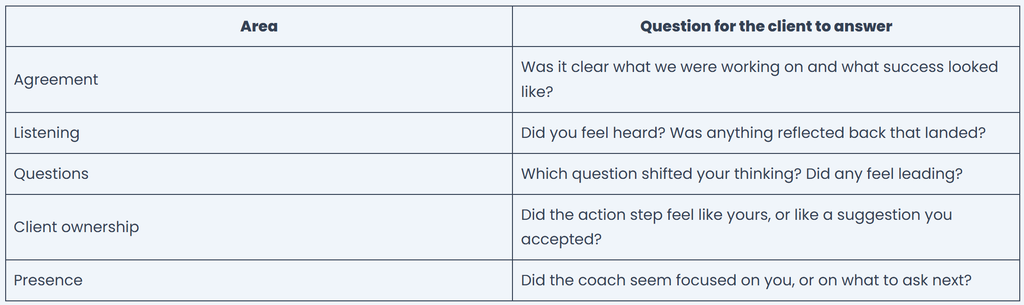
If you want structure, use the ICF Core Competencies as a lens. A few questions that map to them well:
One or two concrete takeaways per session is plenty. Write them down before the return session so you can practice them when you swap.
Common peer coaching mistakes to avoid
- Sliding into a chat. Two coaches who like each other can drift into a friendly conversation. If you notice you are trading stories, come back to the agreement.
- Advising instead of coaching. Peers often share a field or background, which makes “Have you tried…” tempting. Ask instead: “What options do you see?”
- Skipping the agreement. Without a clear goal, the session wanders and the action step has nothing to anchor to.
- Going easy on feedback. Vague praise feels nice and teaches nothing. Kind and specific is the standard.
- Letting the return session slide. If one person coaches three times and gets coached once, resentment follows. Book both sessions up front and honor them.
- Treating it as less real. The skills you build here are the ones your paying clients will experience. Prepare and show up the same way.
Do peer coaching sessions count toward ICF hours?
Yes, in most cases. ICF’s experience requirements list barter, including peer-to-peer coaching, as a form of payment. That means a peer exchange can count as paid hours, which is the harder category to fill.
A few conditions to keep in mind:
- It has to happen outside your training program. Coaching done as part of class, or with your classmates, trainers, or mentors, doesn’t count unless it happens outside the classroom with a real client and separate from your training credits.
- The hours must come after your coach training started. ICF counts hours completed after you begin coach-specific education.
- Partial sessions count partially. A 45-minute session is 0.75 hours.
- Each partner is one client. Credentials also require a minimum number of distinct clients, so exchanging with several peers helps more than many sessions with one person.
For reference, ICF currently requires:
| Credential | Total hours | Paid hours | Minimum clients |
|---|---|---|---|
| ACC | 100 | 75 | 8 |
| PCC | 500 | 450 | 25 |
| MCC | 2,500 | 2,250 | 35 |
Log every session the same day. For each partner, ICF asks you to record their name, contact information, the start and end dates of the coaching, and your paid and pro bono hours. Get your partner’s consent to be listed, since logs can be requested in an audit. ICF offers a free coaching log template on the same page.
Rules can change, so check ICF’s current requirements before you apply.
Where to find a peer coaching partner
The hardest part of peer coaching is usually finding reliable partners. Some common places to look:
- Your training cohort. Classmates are a natural fit, as long as the sessions happen outside class time and assignments.
- ICF chapters and communities. Local chapters and ICF’s member community are good places to meet coaches at a similar stage. ICF also runs its own reciprocal peer coaching program for members.
- A matching service like Coach Practice Exchange. Coach Practice Exchange matches trained coaches with each other for reciprocal sessions. We introduce you to a partner, share contact details, and you schedule directly. Every member agrees to a code of conduct that includes returning the sessions they receive, and you get a fillable ICF-style log sheet to track your hours. CPE is an official ICF Business Solutions Partner.
Whichever route you take, a good partner is one who shows up, takes the client role seriously, and gives you honest feedback. Find two or three of them and you will build skill and hours far faster than practicing alone.
Ready to find a partner? Join Coach Practice Exchange and get matched with a fellow coach.