
For most coaches, an ICF credential is worth it. It doesn’t make you a better coach overnight, but it changes how clients see you, and the work you do to earn it makes you a better coach along the way.
If you’ve finished coach training, you’ve probably asked yourself: should I start taking clients now, or wait until I have my ACC? The honest answer is that you can do both. Coaching before you’re credentialed is how most coaches earn the hours they need. But knowing what a credential actually changes, for your clients and for your practice, helps you decide how hard to push toward it.
This guide covers what an ICF credential is, what it means to clients, what it changes for your business, what you can do before you have one, and how to get there faster.
What is an ICF credential?
An ICF credential is a professional designation from the International Coaching Federation. It shows you have completed coach-specific training, logged real coaching experience, worked with a mentor coach, and passed ICF’s assessments. There are three levels:
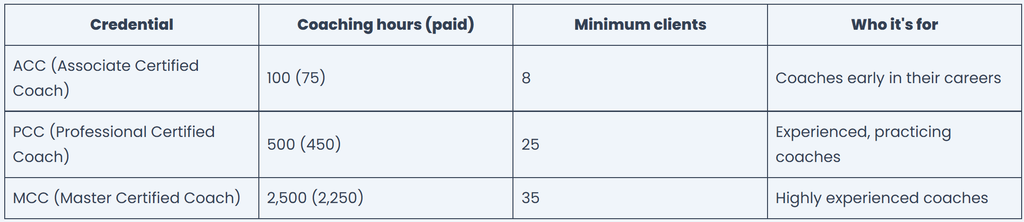
For the ACC specifically, ICF also requires 60 hours of coach training, 10 hours of mentor coaching over at least three months, a performance evaluation, and a passing score on the ACC exam. The application fee runs from $175 to $625 depending on your training path and whether you’re an ICF member.
A note on terms: people often search for “ICF certification,” but ICF calls its designations credentials. Your training program may give you a certificate; the ICF credential is the separate designation ICF awards.
What an ICF credential changes for your clients
Coaching is an unregulated field. Anyone can call themselves a coach, and clients know it. An ICF credential gives them a way to tell who has been trained and assessed against a public standard.
Here is what clients get when they work with a credentialed coach:
- A defined standard of practice. Credentialed coaches are assessed against the ICF Core Competencies, such as building a clear coaching agreement, listening actively, and evoking awareness. Clients can expect a structured session, not an advice chat.
- A code of ethics with teeth. Credential holders agree to the ICF Code of Ethics, covering confidentiality, conflicts of interest, and honest representation. Clients have a formal complaint process if something goes wrong.
- Verification. Anyone can look up a credential in ICF’s public “Verify a Coach” directory. That matters to clients who have been burned by self-titled coaches.
- Ongoing development. Credentials must be renewed every three years with 40 hours of continuing coach education, including ethics. Clients are working with someone who is still learning.
Clients notice. In ICF’s 2022 Global Consumer Awareness Study, 85% of coaching clients said it was important or very important that their coach held a certification or credential. Coaches see the same thing: in the 2023 ICF Global Coaching Study, 80% of coach practitioners agreed that clients expect their coaches to be certified or credentialed.
What it changes for your coaching practice
The biggest shift is that a credential is fast becoming the norm, not the exception. In the 2023 ICF Global Coaching Study, 85% of coach practitioners said they held a certification or credential from a coaching organization, up from 74% in 2019 and 69% in 2015. If most of the coaches a client compares you with are credentialed, not having one stands out.
In practice, an ICF credential tends to help in a few ways:
- Easier sales conversations. You spend less time proving you’re qualified and more time talking about the client’s goals.
- Access to organizational work. Companies and coaching firms that hire coaches commonly ask about credentials. If you want to coach inside organizations, expect the question.
- Room to raise your rates. ICF reports that coaches with a professional credential earn a higher average annual income from coaching than those without one. For context, the average fee for a one-hour session in the 2023 study was $244.
- A clear next step. Once you have your ACC, the PCC gives you a defined path to keep growing, instead of guessing what “more experienced” means.
A credential is a signal, not a guarantee. It opens doors, but you still have to walk through them.
Coaching before you’re credentialed: what you can do now
You don’t need an ICF credential to start coaching. In fact, you can’t earn the ACC without coaching first: ICF requires 100 hours of client coaching, all logged after your coach training began. Coaching early isn’t a shortcut around the credential. It’s the road to it.
Here is how coaching before and after an ACC typically compares:
| Before your ACC | After your ACC | |
|---|---|---|
| Who you can coach | Anyone who hires you | Anyone who hires you |
| How you describe yourself | Trained coach, or “pursuing my ICF ACC” | ICF Associate Certified Coach (ACC) |
| How clients verify you | Your training, testimonials, references | ICF’s public directory, plus the above |
| Typical clients | Peers, your network, pro bono, early paid clients | A wider market, including clients who screen for credentials |
| Pricing | Usually lower while you build experience | More room to charge market rates |
| What the hours do | Count toward your credential | Count toward your PCC |
A few ground rules for the early stage:
- Be honest about where you are. Never call yourself ICF certified or credentialed until ICF has awarded it. “Trained coach working toward my ACC” is accurate and still reassuring to clients.
- Coach to the standard anyway. Use the ICF Core Competencies and Code of Ethics from day one. Your clients get the same quality of coaching, and you build the habits the performance evaluation looks for.
- Log everything. Record each client’s name, contact details, dates, and paid versus pro bono hours as you go. Rebuilding a log later is painful.
- Ask for feedback. Early clients, especially other coaches, can tell you what’s working. That accelerates your growth more than hours alone.
What an ICF credential won’t do
It helps to go in with clear expectations:
- It won’t bring you clients on its own. You still need a niche, a way to reach people, and a reason for them to choose you.
- It won’t replace a strong first impression. Clients hire coaches they connect with. The credential gets you considered; the conversation gets you hired.
- It isn’t permanent without upkeep. You’ll renew every three years, with 40 hours of continuing coach education each cycle.
- It isn’t a legal license. Coaching isn’t licensed the way therapy is, and a credential doesn’t qualify you to work outside coaching’s scope.
How to earn your ICF credential faster
For most new coaches, the slowest part of the ACC isn’t the training or the exam. It’s the 75 paid hours. Finding paying clients while you’re still building confidence is hard, and pro bono hours only take you so far.
This is where reciprocal coaching helps. ICF’s experience requirements count barter as payment, including peer-to-peer coaching done outside a training program. When you coach a fellow coach and they coach you in return, those hours can count as paid hours. Each partner also counts as a separate client toward ICF’s minimum client numbers.
The same applies after your ACC. The PCC requires 500 hours, 450 of them paid, with at least 25 clients. Peer exchanges can keep filling that gap while you grow your paying client base.
Coach Practice Exchange matches trained coaches for reciprocal coaching sessions. We introduce you to a partner, share contact details, and you schedule directly. Every member agrees to a code of conduct that includes returning the sessions they receive, and you get a fillable ICF-style log sheet to track your hours. CPE is an official ICF Business Solutions Partner.
Working toward your ACC or PCC? Get matched with a fellow coach and start building your hours.
Frequently asked questions
Is an ICF credential worth it? For most coaches, yes. Clients increasingly expect it, most of your competitors already have one, and the process itself builds your skills. It won’t replace marketing, but it makes every client conversation easier.
What’s the difference between ICF certification and an ICF credential? They usually mean the same thing in searches. Officially, ICF awards credentials (ACC, PCC, MCC). Training programs award their own certificates, which are separate from an ICF credential.
Can I coach without an ICF credential? Yes. Coaching isn’t regulated, and you need to coach clients to earn the credential in the first place. Just don’t describe yourself as ICF credentialed until you are.
How long does it take to get an ICF credential? It depends mostly on how fast you log hours. Mentor coaching alone takes at least three months. If you coach about two hours a week, reaching 100 hours takes roughly a year; more clients or peer exchanges shorten that.
How much does the ACC cost? The ICF application fee is $175 to $625, depending on your training path and ICF membership. Training, mentor coaching, and membership are separate costs.