
PCC Markers in one minute
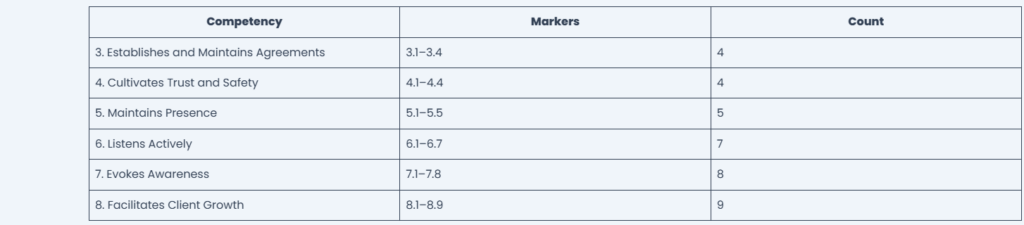
The PCC Markers are 37 observable behaviors the International Coaching Federation (ICF) uses to judge whether a coaching conversation shows Professional Certified Coach (PCC) level skill. They sit under six of the eight ICF Core Competencies, from setting the session agreement to closing with clear next steps.
If you are working toward your PCC, the markers are the closest thing ICF publishes to a scoring guide. This article explains each one in plain English, covers the big 2027 change to how they’re used, and shows how to practice them until they stop feeling like a checklist.
The current version was revised in November 2020 (rev. June 2021) and is still the official set ICF links to today. Always check the official ICF PCC Markers page for the latest version.
What the PCC Markers are (and aren’t)
ICF describes the markers as the indicators an assessor is trained to listen for in a recorded session. They tell the assessor which Core Competencies are showing up, and how strongly. A candidate needs to demonstrate a minimum number of them to pass.
Three things trip people up:
- Competencies 1 and 2 have no numbered markers. Ethical Practice is expected throughout the session. Coaching Mindset is assessed through 11 markers borrowed from other competencies: 4.1, 4.3, 4.4, 5.1–5.4, 6.1, 6.5, 7.1 and 7.5.
- The markers describe PCC level, not perfection. They show what solid professional coaching looks like in one conversation, not everything a great coach does over time.
- ICF says not to use them as a checklist. The guidance is explicit: the markers support competency development and should not be ticked off formulaically to pass. A session that hits markers mechanically usually sounds forced, and that costs you elsewhere.
The markers are also widely used outside the exam. Mentor coaches, coach trainers and peer practice partners use them as a shared language for feedback.
All 37 PCC Markers, explained in plain English
Below is every marker, paraphrased, with what it tends to sound like in a real session. For the exact official wording, use ICF’s PDF.
Competency 3: Establishes and Maintains Agreements
This is the session agreement. Most failed recordings slip here first.
- 3.1 Work with the client to name or reconfirm what they want from this session.
- 3.2 Agree on how the client will know the session was successful.
- 3.3 Explore why this goal matters to the client.
- 3.4 Work with the client to define what they need to address to get there.
In practice: “What would you like to leave with today?” then “How will you know you’ve got it?” then “Why does that matter now?”
Competency 4: Cultivates Trust and Safety
- 4.1 Recognize the client’s strengths, insights and effort.
- 4.2 Show support, empathy or concern.
- 4.3 Acknowledge the client’s feelings, views, concerns, beliefs or ideas.
- 4.4 Invite the client to respond to your contributions, and accept whatever they say.
In practice: after sharing an observation, ask “How does that land?” and genuinely let a “no” stand.
Competency 5: Maintains Presence
- 5.1 Respond to the whole person, not just the problem (the who).
- 5.2 Stay responsive to the client’s goal throughout the session (the what).
- 5.3 Let the client choose what happens next in the session.
- 5.4 Show curiosity about the client.
- 5.5 Allow silence, pauses and reflection.
In practice: offer choices (“Where would you like to go from here?”) and resist filling a pause.
Competency 6: Listens Actively
- 6.1 Tailor questions and observations to what you’ve learned about the client.
- 6.2 Explore the specific words the client uses.
- 6.3 Explore the client’s emotions.
- 6.4 Notice and explore energy shifts, nonverbal cues or behaviors.
- 6.5 Explore how the client sees themself or their world.
- 6.6 Let the client finish without interrupting, unless there’s a clear coaching reason.
- 6.7 Briefly reflect or summarize to check understanding.
In practice: “You said ‘stuck’ twice. What does stuck feel like?”
Competency 7: Evokes Awareness
- 7.1 Ask about the client: their thinking, feelings, values, needs, wants, beliefs or behavior.
- 7.2 Help the client see themself in a new or wider way (the who).
- 7.3 Help the client see their situation in a new or wider way (the what).
- 7.4 Help the client explore beyond their current approach toward the outcome they want.
- 7.5 Share observations, intuitions or thoughts without attachment, and invite the client to explore them.
- 7.6 Ask clear, direct, mostly open questions, one at a time, with room to think.
- 7.7 Keep your language clear and concise.
- 7.8 Let the client do most of the talking.
In practice: one short question, then stop. Stacked questions and long preambles cost you 7.6 and 7.7.
Competency 8: Facilitates Client Growth
- 8.1 Invite the client to look at progress toward their session goal.
- 8.2 Invite the client to name what they learned about themself.
- 8.3 Invite the client to name what they learned about their situation.
- 8.4 Invite the client to consider how they’ll use what they learned.
- 8.5 Co-design reflection or action for after the session.
- 8.6 Explore how to move forward, including resources, support and barriers.
- 8.7 Let the client design their own accountability.
- 8.8 Celebrate the client’s progress and learning.
- 8.9 Agree with the client on how to close the session.
In practice: leave 10 minutes for the close. Rushed endings are one of the most common reasons coaches miss Competency 8.
What changes in 2027 (and why the markers still matter)
ICF is replacing the recorded Performance Evaluation for ACC and PCC Portfolio candidates with an enhanced mentor coaching requirement. The markers don’t go away; who applies them does.

What this means for you:
- Before April 1, 2027: you can still submit a recording through the existing Performance Evaluation route.
- After April 1, 2027: your MCS mentor coach observes your coaching and validates your competence. Expect them to give feedback in the language of the Core Competencies and markers.
- Choose your mentor coach carefully. Confirm they hold, or are completing, the MCS at the right level (MCS-ACC, MCS-PCC or MCS-MCC).
Either way, the skills the markers describe are what you’ll be judged on. Fluency with them before mentor coaching starts makes those hours far more useful. Details may still evolve, so check ICF’s announcement on the change before you plan your timeline.
Want to Become an ICF Mentor Coach?
As the ICF credentialing process evolves, the ability to accurately evaluate coaching competencies and provide meaningful developmental feedback is becoming increasingly important.
For experienced coaches ready to advance into mentor coaching, iNLP Center’s 41-Hour Mentor Coach Specialization (MCS) Training provides in-depth preparation in ACC BARS, PCC Markers, competency evaluation, and evidence-based feedback.
The program combines online coursework with live training, observed mentor coaching, mentoring supervision, and a final competency assessment. You’ll learn to recognize the differences between ACC- and PCC-level coaching, evaluate performance objectively, and help other coaches strengthen their skills.
Ready to develop your expertise as an ICF mentor coach?
How to practice the PCC Markers
Reading the markers is easy. Doing them naturally, under the pressure of a real client, takes repetition. Here’s a practice routine that works:
- Learn them one competency at a time. Spend a week on Agreements (3.1–3.4) before moving on. Trying to hold all 37 at once makes sessions stiff.
- Record your sessions (with consent). Listen back with the marker list beside you. Note which markers showed up and which were missing.
- Transcribe one session a month. Transcripts make stacked questions, interruptions and long talking turns obvious in a way audio doesn’t.
- Get marker-based feedback. Ask a mentor coach or peer to tell you, by number, what they saw and what they didn’t.
- Practice with real coaching conversations, not role-plays. Real topics bring real emotion and resistance, which is where 4.x, 6.3 and 6.4 actually get tested.
- Fix one gap at a time. Pick the single marker you miss most and focus on it for your next five sessions.
Where to get the practice hours
Most coaches working toward PCC need two things at once: more coaching hours and more chances to sharpen their skills. Peer coaching exchanges can help with both.
Coach Practice Exchange matches trained coaches with each other for reciprocal sessions: you coach a peer, and they coach you. Each session is a real conversation where you can practice the markers, and you also experience them from the client’s chair. Depending on your situation, these sessions may count toward your ICF client coaching hours; check ICF’s current rules for your credential path. CPE also provides a fillable, ICF-style coaching log to keep your records tidy.
Peer practice complements mentor coaching; it doesn’t replace it. Your required mentor coaching hours still need to be with a qualified mentor coach.
Need ICF Mentor Coaching for Your ACC or PCC?
Practicing with peers is an excellent way to develop your coaching skills, but personalized feedback from an experienced mentor coach helps you recognize strengths, identify competency gaps, and prepare for ICF credentialing.
iNLP Center’s 10-Hour ICF Mentor Coaching Program offers a flexible combination of seven live small-group mentor coaching clinics and three private mentoring sessions with an ICF-credentialed mentor coach.
You’ll receive competency-focused feedback, review coaching demonstrations, and strengthen your ability to demonstrate the ICF Core Competencies and PCC Markers in real coaching conversations.
The program is open to coaches from iNLP Center and other training organizations, with flexible scheduling and opportunities to begin throughout the year.
Take the next step toward your ICF credential.
7 common PCC Marker mistakes
- A fuzzy agreement. The client names a topic but never a session outcome or a measure of success (3.1, 3.2).
- Skipping the “why.” Moving straight to solutions without exploring what makes the goal important (3.3).
- Stacked questions. Asking two or three questions in one breath instead of one clear question (7.6).
- Talking too much. Long setups, teaching or advice that tip the talk ratio toward the coach (7.7, 7.8).
- Coaching the problem, not the person. Staying on the situation and never exploring who the client is in it (5.1, 7.2).
- Sharing with attachment. Offering an observation, then defending it when the client disagrees (4.4, 7.5).
- A rushed close. Running out of time before learning, next steps and accountability are explored (8.2–8.7).
PCC Markers FAQ
There are 37, spread across Core Competencies 3 through 8. Competencies 1 and 2 have no numbered markers of their own.
ICF hasn’t announced new markers. What’s changing is the process: from April 1, 2027, ACC and PCC Portfolio candidates no longer submit a recorded Performance Evaluation. MCS mentor coaches validate skills instead.
No. ICF requires a minimum number of markers per competency, not all 37. A natural session that clearly shows each competency matters more than ticking boxes.
ICF publishes PCC Markers specifically. ACC and MCC are assessed against the same Core Competencies at different levels of depth.
On ICF’s PCC Markers resource page, available in English and more than a dozen other languages.
Practice real sessions, review your recordings against the list, and get feedback by marker number. A reciprocal peer exchange like Coach Practice Exchange gives you regular sessions to do exactly that.